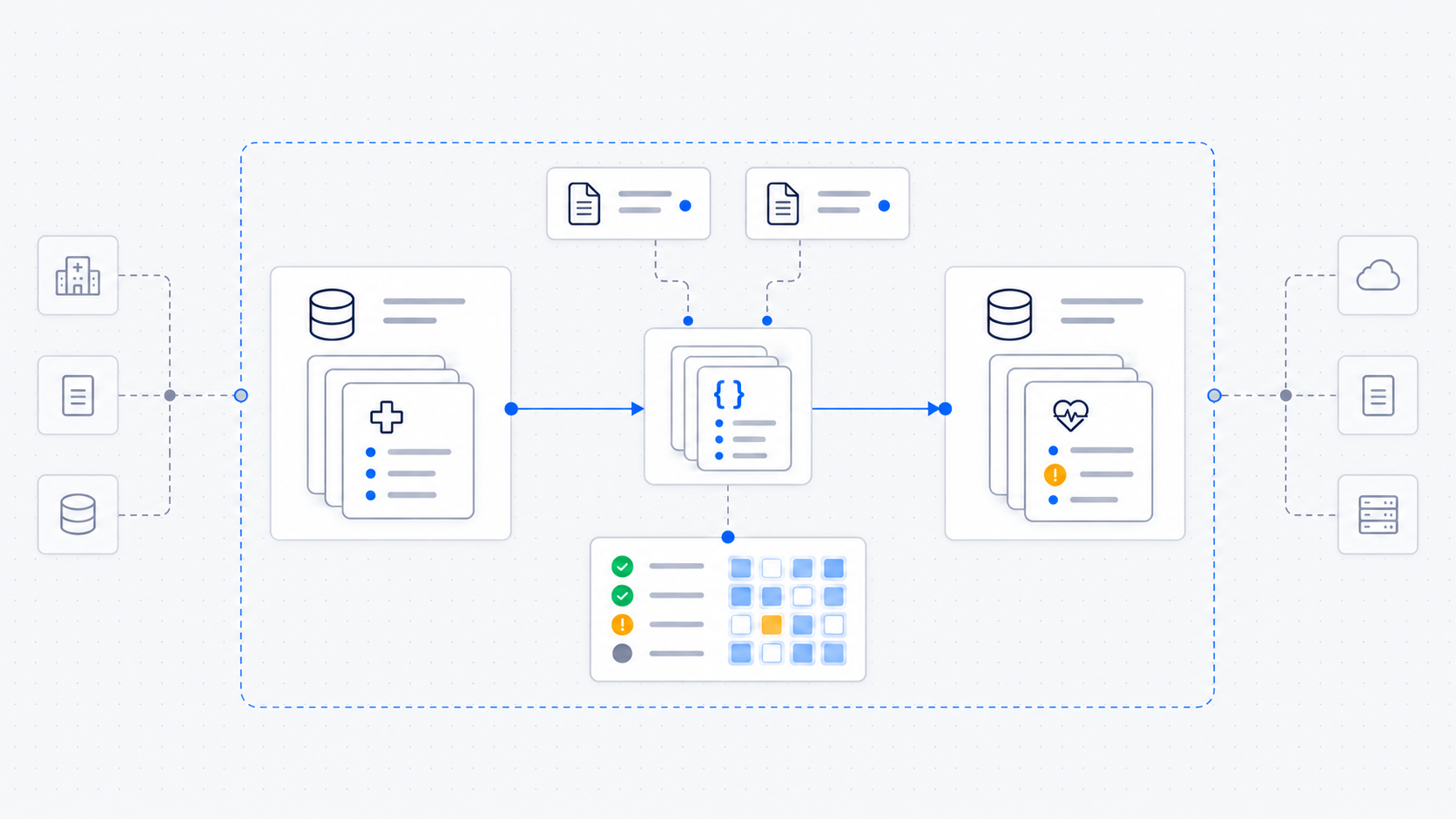
As the European Health Data Space (EHDS) moves from legislation into technical implementation, teams across Europe face a practical question: when you validate a European Patient Summary (EPS) against an evolving HL7 Europe Implementation Guide, how do you know what was actually checked, what could not be evaluated, and whether a fix changed the result under the same basis?
For our session at the HL7 Europe Working Group Meeting in Málaga (16–20 November 2026), we walked through a real synthetic EPS from SYNDERAI, hosted on a Health Samurai (Aidbox) test server. The rehearsal on 17 November 2026 ran in a local Records build reading the live test source read-only, with zero writes back to the server.
What happened along the way illustrates three realities every EHDS engineering team will hit long before formal certification: package versions drift faster than labels, real-world servers add extensions whose definitions are missing, and a meaningful recheck requires keeping the validation basis visible.
Pin the exact profile build — labels are not enough
The selected document (Bundle/01a158b8-ca29-77a9-858a-42d872a2f479) is a 34-entry, 8-section synthetic European Patient Summary for Eugène Pineau. Like many real-world FHIR payloads, the Bundle declares unversioned profile canonicals.
In an initial check against hl7.fhir.eu.eps#1.0.0-ballot, four MedicationStatement profiles failed to resolve. The reason was a single-letter casing change between releases: the ballot package used uppercase MedicationStatement-eu-eps, whereas the SYNDERAI data used the updated lowercase official EPS CI canonical introduced in HL7 Europe's EPS repository.
The wrong shortcut here would be aliasing the canonical or rewriting the source payload just to make the error disappear. Instead, we imported and pinned the actual official CI archive (hl7.fhir.eu.eps#1.0.0-ci-build, built 20261113140830, SHA-256 a08373a1..., alongside dependencies including hl7.fhir.uv.ips#2.0.1 and hl7.fhir.eu.base#2.0.1). All four MedicationStatement profiles resolved immediately.
Because a CI build can change from day to day, the version label 1.0.0-ci-build alone does not identify what ran. Keeping the archive timestamp and SHA-256 checksum makes the basis inspectable — while keeping clear that a CI build is a preview, not a published edition or an EHDS conformance certificate.
Read the document result — and keep Partial visible
With the pinned EPS CI package active, validating the full 34-entry Bundle returned 5 errors, 4 warnings, and 28 information messages — with Partial coverage.
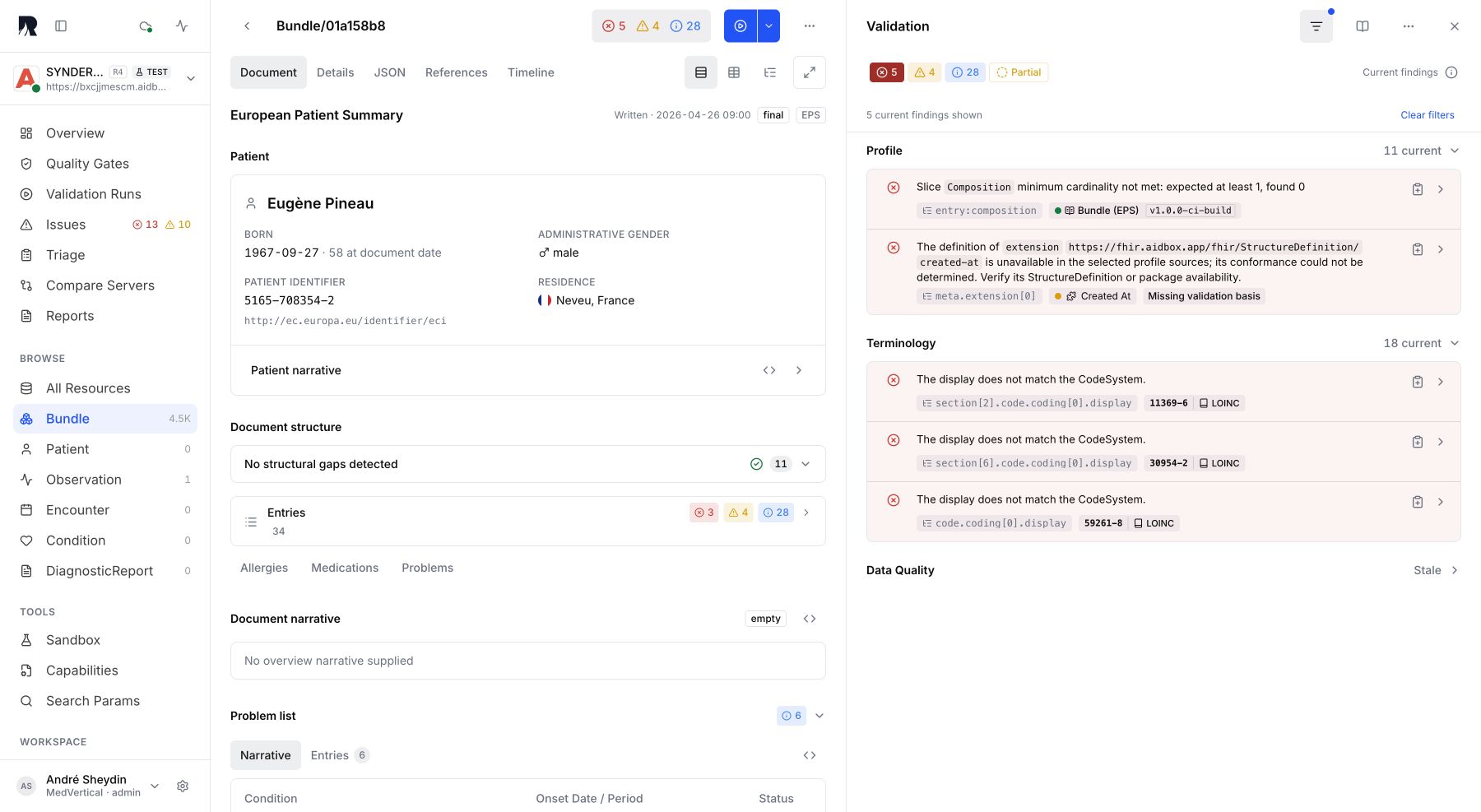
Local Records rehearsal (17 November 2026, validator 0.10.3) reading the live synthetic SYNDERAI · Health Samurai source read-only. The Partial badge stays visible because the Aidbox created-at extension definition is unavailable.
That Partial status is often the most important signal in an exchange review. Here, the server attaches an Aidbox metadata extension (https://fhir.aidbox.app/fhir/StructureDefinition/created-at). Searching the source server returned zero matching StructureDefinition resources, and requesting the canonical URL returned HTTP 404. While the vendor documents the extension in its Aidbox Read API guide, no retrievable StructureDefinition was available to validate it against.
We did not invent a placeholder definition, strip metadata from the document, or suppress the check. When an extension cannot be evaluated, leaving the coverage gap visible lets the receiving team decide whether that gap matters for their handover.
The remaining four errors were equally concrete and separate from that coverage gap:
- one
Compositionslice minimum-cardinality error (entry:compositionagainstBundle (EPS) v1.0.0-ci-build); - three LOINC display mismatches (
11369-6,30954-2, and59261-8).
Each finding points to a specific path and requirement to investigate before anyone treats the document as conformant.
Verify one controlled correction on a fixed basis
To demonstrate a before-and-after correction without modifying the shared SYNDERAI server, we switched to a focused, bounded Sandbox check on the document's embedded synthetic Patient (d242c8f6-ac25-4f06-9638-b25dfef23d0c). Because the Bundle check and the Patient Sandbox check cover different scopes and settings hashes, their totals are not compared directly.
The original SYNDERAI Patient already contains "birthDate": "1967-09-27". For a clean negative control, we deliberately removed birthDate in a temporary test copy (patient-missing-birthdate.json) — this illustrates the validation loop and does not report a defect in SYNDERAI.
Patient check (Patient (EPS)) | Before (birthDate removed) | After (1967-09-27 restored) |
|---|---|---|
| Errors / Warnings / Info | 1 / 0 / 2 | 0 / 0 / 2 |
| Resolved findings | — | 1 (birthDate) |
| Settings hash | aa61c7b56594c894 | aa61c7b56594c894 |
On the first check, Records flagged the missing birthDate required by Patient (EPS) v1.0.0-ci-build, alongside two informational metadata hints (meta.lastUpdated and meta.versionId). After restoring only "birthDate": "1967-09-27" in the temporary draft and revalidating, the error count dropped from one to zero, Records marked 1 error resolved, and the two metadata hints remained visible. No write was sent to the Health Samurai source server.
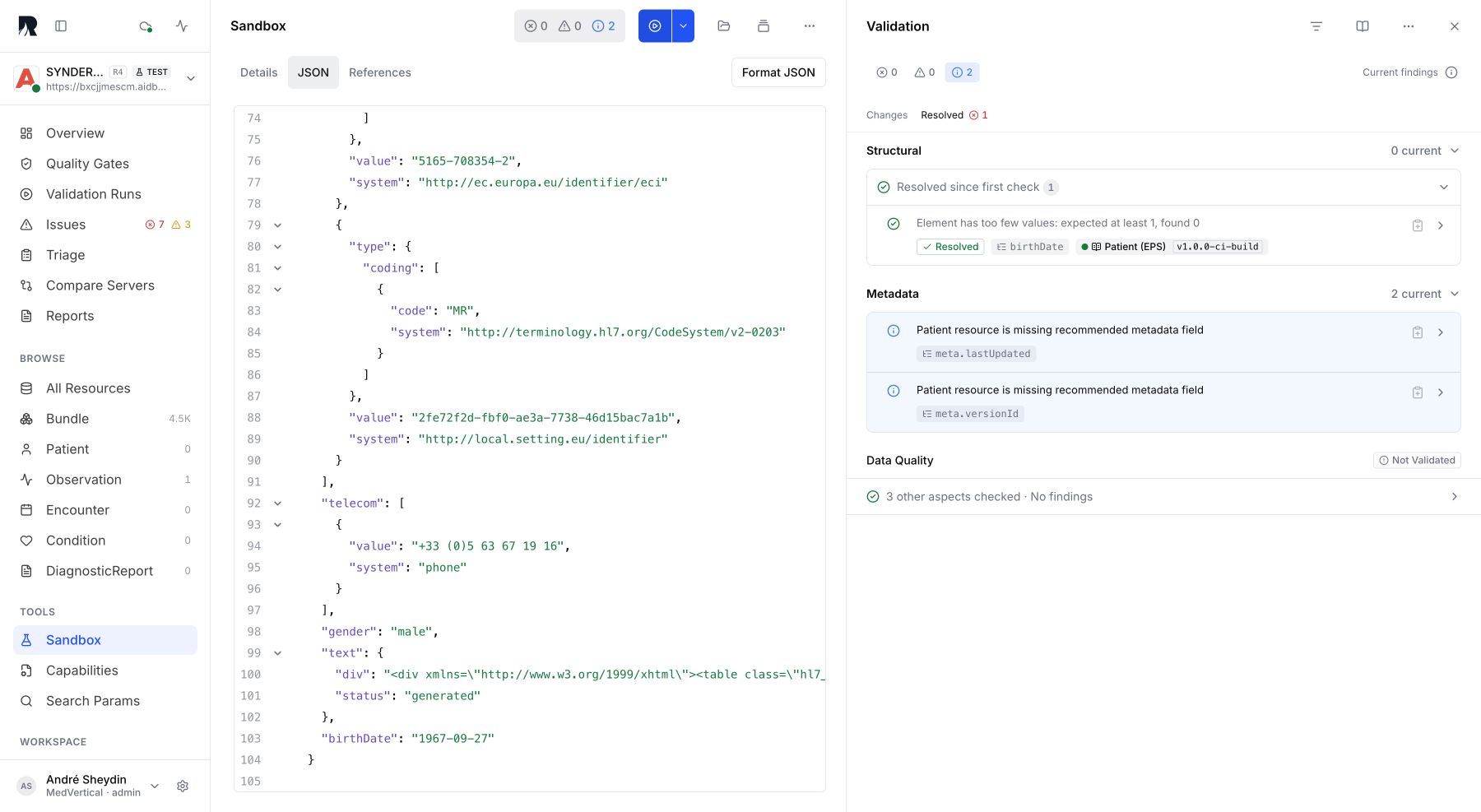
Temporary Sandbox recheck on 17 November 2026. Restoring only birthDate resolved the single structural error while keeping the two metadata hints and Data Quality status explicit.
Separate data changes from validation-basis changes
A FHIR resource can pass a check today and fail tomorrow even when its JSON never changes — because profiles, terminology expansions, or surrounding resources moved. Whenever a finding count changes, teams need to separate two questions: did the data change, or did the validation basis change?
In Málaga, we framed the validation basis around four elements worth recording on every check:
- Validator version and ruleset (
0.10.3, ruleset2026.11.11.2). - Implementation guide packages and dependencies (
hl7.fhir.eu.eps#1.0.0-ci-buildarchive SHA-256,hl7.fhir.uv.ips#2.0.1,hl7.fhir.eu.base#2.0.1). - Terminology editions and expansions.
- Validation settings and selected scope.
Opening Technical details after the recheck makes that boundary concrete: the input hash changed when birthDate was restored (310d9cbb... → a3ba442d...), while the settings hash remained identical (aa61c7b56594c894).
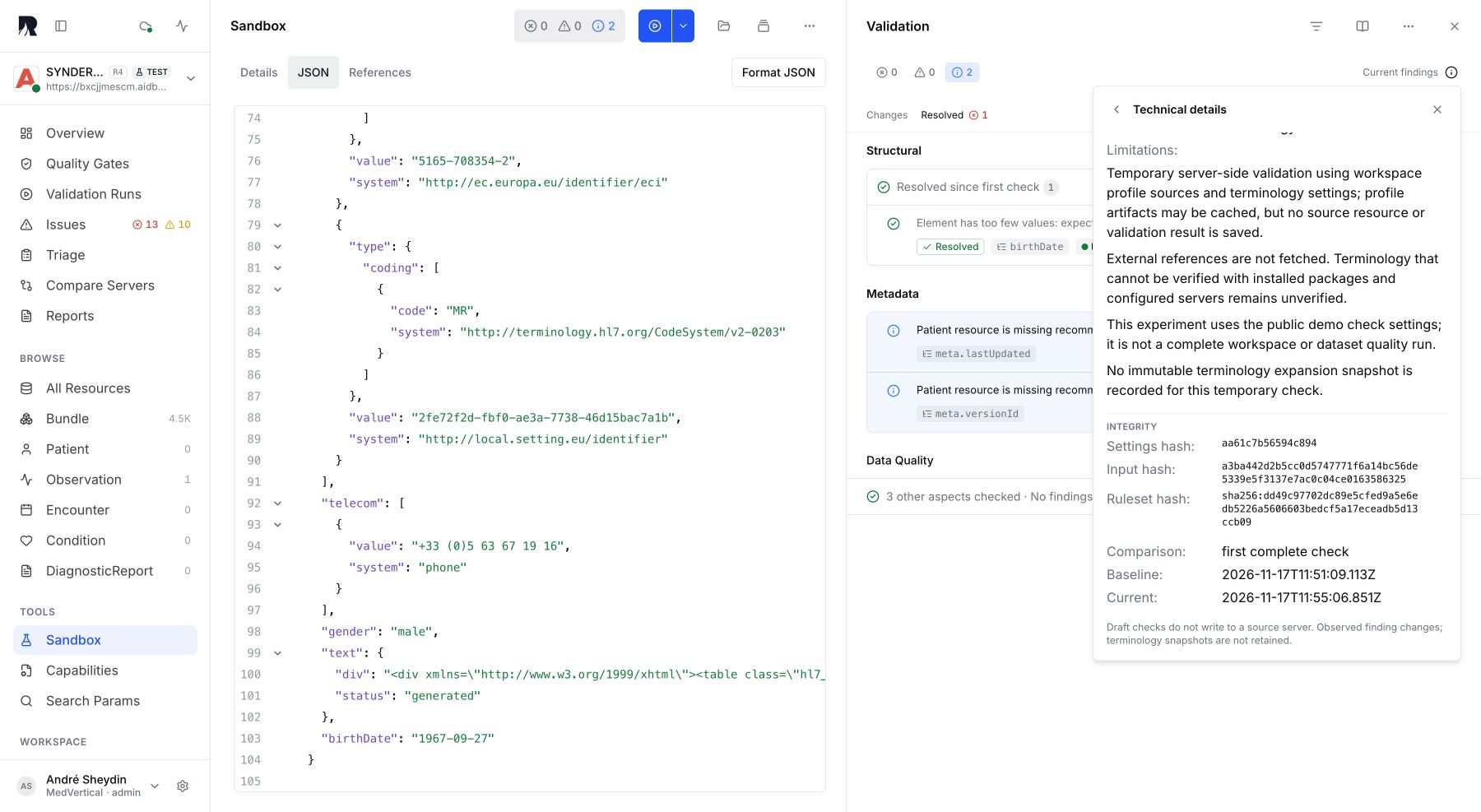
Validation context from the 17 November 2026 Sandbox check: the same settings hash (aa61c7b56594c894) spans both runs, while explicit limitations note that no immutable terminology snapshot was recorded.
Just as importantly, the panel records its own limitations in plain text: this was a temporary draft check, no source resource was written, and terminologySnapshot was null (no immutable terminology expansion snapshot was retained). A complete offline replay later would still require keeping those remaining runtime and terminology inputs. Likewise, Data Quality Assessment (DQA) was not run in this single-resource check — dataset-level questions such as duplicate identifiers or broken cross-resource references belong to a separate layer.
About the example and its evidence
The downloadable rehearsal summary records the 17 November 2026 local rehearsal on synthetic SYNDERAI data: exact file hashes, the EPS CI archive SHA-256, validator and ruleset versions, both Patient check hashes, the Partial document counts, screenshot checksums, and the explicit boundaries above.
It documents a local rehearsal against a live synthetic test server — not a hosted deployment qualification, not a completed partner evaluation, and not an official EHDS certification or data-quality label.
You can explore synthetic SYNDERAI documents directly in the public Records demo or walk through package-level checks in the HL7 Europe guide. If your team is preparing an EHDS exchange or a shared health data space handover, request workspace access to test one permitted Bundle against pinned profiles and review the findings together.
Written with AI assistance.